PT EN ES

Learn 7 fun facts about gold

Gold is one of the most prized metals in the world due to its unique characteristics. Color, versatility and durability are some of them. Discover 7 fun facts about this valuable metal.

1 – Gold and copper were the first metals to be discovered by humans, around 5000 BC.·

2 – From 3 to 8 grams of gold are extracted for each ton of processed ore. It comes out as a powder, not as nuggets or stones. Only afterwards is it processed, melted and formatted into bars.

3 – Today, most of the world’s gold production goes to the jewelry market, financial sector (central bank reserves) and industry and technology (electronics, dental and medicine).

4 – Gold is present in smartphones. Inside them can be up to 34 milligrams of gold. It is in the micro electrical connections of processors and is widely used in microelectronics (TVs, computers and medical equipment), as it is an excellent conductor of electricity.

5 – In addition to being a very stable element, gold does not oxidize and is therefore more reliable than other metals.

6 – It is also present in artificial satellites, for being an excellent reflector, and as a catalyst in the automotive industry.

7 – Among the largest gold producers in Brazil, AngloGold Ashanti is the only one that allocates part of its production to the manufacture of jewelry sold on the domestic market. The company was chosen by the largest jewelry chain in the country for its high standards of governance and its commitment to safety and sustainability, guaranteed by certifications such as the LBMA – London BullionMarket Association, known as “Responsible Gold”.

Source: AngloGold Ashanti Communication Office

Discover eight curiosities about mining in Colonial Brazil

Do you know where the first diamonds were found in Brazil? And how did the expression Santo do pau hollow come about? The history of mining in Colonial Brazil involves a series of interesting facts.

See below 8 curiosities about the period:

1) And isn’t it that, with the arrival of mining in Colonial Brazil, the Portuguese language replaced Tupi, thus becoming the most widely spoken language in the colony? This is because, due to this new economic activity, the number of Portuguese in the territory increased. Another change caused by colonial mining was the displacement of the Brazilian capital from Salvador to Rio de Janeiro, as it was closer to the mines. In addition, with the wealth brought by gold extraction, a new consumer class emerged in Colonial Brazil, the Brazilian middle class.

2) And where were the first diamonds found in Brazil? In the region of the Jequitinhonha River, in 1729. The river flows through the states of Minas Gerais and Bahia. The main production center was Arraial do Tijuco, currently known as Diamantina, in Minas Gerais.

3) Colonial mining was the setting for the origin of famous popular sayings. This is the case of the expression Santo do Pau Oco, used to designate disguised people. As taxes on gold and other precious metals were very high at the time, hollow wooden saints were filled with precious goods such as powdered gold. Thus, it was possible to pass through the Foundry Houses without paying the abusive taxes imposed on the Crown.

4) Speaking of taxes…did you know that the first tax in Brazil came about during the colonial mining period? Called the fifth, it stipulated that 20% of the wealth obtained in each deposit should be granted to the Portuguese Crown. But the system was very vulnerable and ended up being replaced, later on, by the feint, which consisted of sending 30 arrobas of gold per year to the Crown.

5) That the city of Ouro Preto, in Minas Gerais, has that name due to the local exploitation of gold, everyone knows. But the question remains: why ‘black’? The answer is simple: the gold in the region was covered with a layer of iron oxide, which gave it a different hue than normal. By the way, until 1823, the city was called Vila Rica.

6) Thanks to colonial mining, gold production in Brazil represented half of world gold production between the 16th and 18th centuries! And, of course, there were people who became very rich. Legend has it that a slave named Chico Rei managed to buy his own freedom and that of other slaves with gold smuggled from the Mina Encardideira, in Ouro Preto, where he worked.

7) What does the Industrial Revolution have to do with mining in Colonial Brazil? A lot of things! The gold was taken to Portugal and generated profit even for England, which would have financed the Industrial Revolution with part of the riches taken from the Portuguese colony. And it wasn’t just profit that gold extraction generated. With it came the arts, represented mainly by Aleijadinho, and the intellect. Children of Portuguese-Brazilian origin were sent to Portugal to study and, when they returned to Brazil, they brought with them the revolutionary and embryonic ideas of the French Revolution.

8) Colonial mining even affected the population flow in the territory. With the promises of wealth in the New World, an intense immigration of Portuguese to Brazil began. And the colony’s official population jumped from 300,000 to 3 million! Concerned about the growing number, the Crown even stipulated a law to try to manage the migratory flow.?

Source and Illustration: Vale S.A./Photo: Momondo

Find out what is the difference between ore, metal, minerals and rocks

What differentiates an ore from a mineral? Is every metal an ore? Is ore a rock? Sometimes, some doubts may arise concerning mining, mainly due to the business complex characteristic. After all ore is sold directly to other companies and reaches the consumer as an end product, including cell phones, computers and cars.

Check the difference among four terms related to mining that can be easily mixed up.

Minerals

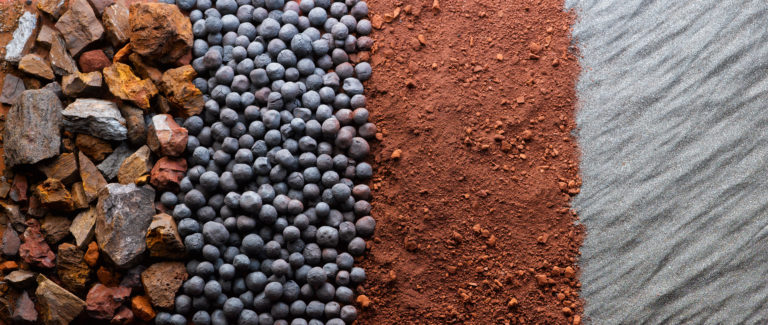
Mineral is a solid and crystalline natural body formed as a result of physicochemical process interactions in geological environments. Each mineral is classified and named not only based on its chemical composition, but also in the crystalline structure of the materials that comprise it. To find out a mineral composition, a chemical and physical analysis is performed, which determines relative proportions of different chemical elements of that mineral and its crystalline structure (for instance, quartz, pyrite, hematite, etc.).

Rock

Rocks are aggregates of one or more minerals. Thus, it can be stated that every rock is comprised by minerals. It is possible to find out what they are made of by means of analyzing their chemical or mineralogical composition. The latter expresses different mineral proportions that comprise the rock.

Ore

It is a rich mineral aggregate in a specific mineral or chemical element that is economically or technologically viable for extraction (mining). Copper, for instance, occurs naturally in some rock types, but it is only possible to become an ore when it concentrates in large quantities and it is possible to be extracted from nature.

Metals

They are the elements extracted from some ores found in soils and rocks – iron and copper are collected from ores in the adequate form to be used; steel and bronze, on the other hand, they need to be associated with other substances. Metals can be separated in two groups: ferrous (comprised by iron), like iron and steel, and non-ferrous, like aluminum, copper and heavy metals (lead, nickel, zinc and mercury).

Copper: a significant ally in virus and bacteria control

Did you know that copper destroys viruses and bacteria? The discovery was performed by the physician Victor Burq in the 19th century, in Paris, according to a paper published on Vice website. At the time, there were cholera outbreaks that reached the city and employees of a copper cast house, that had daily contact with the ore, were not reached by the disease. At the same time, he discovered that other workers handling copper in Paris capital and in other European cities had also prevented cholera.

From a data collection with more than 200 thousand people, he reached a conclusion to France Science and Medicine Academies in 1967, that ‘copper and its alloys, brass and bronze, literally applied in the skin in the cholera epidemic are efficient prevention means and should not be neglected’

Through the years, studies showed that copper is a major ally and has bacterial threat protection: it is an antimicrobial. It was proven that the metal kills a long list of microbes, including norovirus, MRSA, an Staphylococcus bacteria that became resistant to antibiotics, E. coli virulent strains that can cause food intoxications, and coronavirus – possibly the new strain currently causing COVID-19 pandemic.

But why doesn´t the world use more copper? After all, it could reduce microbe presence in main surfaces, a door for the human being to contaminate him/herself with different infirmities. Maybe due to the value. But, as an analysis is performed, it is possible to reverse this situation, as the ore could be a major ally in hospital infections and even in coronavirus pandemic control, thus governments would not have to spend so much in disease cure.

Read the full text in Vice website

Learn more on copper and its relevance to public health

After strict tests and assessments, the United States Environmental Protection Agency filed copper alloys as public health antimicrobial materials. Surfaces touched frequently made of copper alloy materials kill bacteria continuously within two hours of contact, when regularly cleaned.

More than 500 copper alloy types are filed in the United States Federal Insecticide, Fungicide and Rodenticide to control pests without adverse effects to the human being and the environment.

Three major characteristics that make antimicrobial copper alloys highly efficient in contact surface materials:

  • It kills bacteria continuously

It is proven that copper material is much more efficient as an antimicrobial surface than a stainless steel material, and it kills infection-causing bacteria continuously.

  • It never wears out

Even after dry, wet cleaning and contact with infection-causing bacteria, it remains with continuous microbial action efficacy.

  • Safe to use

Copper surfaces are not harmful to people or the environment. It has inherent microbial even without chemicals added. And it is totally recyclable.

Covid-19

A study performed by the United States Centers for Disease and Prevention reported that SARS – CoV-2 virus, that causes Covid-19, is kept alive from two to three days in plastic and stainless steel surfaces, however, in copper alloy surfaces, the virus is kept alive for up to 4 hours.

Such information was obtained from the website https://www.copperalloystewardship.com/

How much nickel is there on your mobile phone?

Imagining a world without cell phones, sometimes, can seem to be very attractive. But reality and practicality state otherwise: the device has become essential to modern life, as well as the nickel so that it works as today.

Nickel in chemical form or in alloy is an essential battery element. It enables lead-free welding, and it also provides protection against emissions, or, inversely, preventing external electromagnetic interferences. Coatings – several containing nickel – make possible every quick or pressure-sensitive motions.

See here where is the nickel in your cell phone:

1 – Lithium Battery – it contains nickel in its composition;

2 – Antenna (in older models) – it has a metallic alloy that contains nickel;

3 – Protection against electromagnetic interface – nickel painting or copper board with nickel overlapping; it also has a case comprised by nickel-plated carbon fibers;

4 – Each chip connection wire – with nickel coating;

5 Each chip diffusion barrier and board – lead-free weld cannot be executed without nickel immersion gold cladding without electricity;

6 – Microphone – it contains galvanized nickel;

7 – Circuit board, SIM card – copper nickel board for protection against oxidation;

8 – Ceramic capacitor – it has nickel in electrodes, interconnections;

9 – Electronics is performed almost entirely by complex coating stacks that have nickel among their elements;

10 – Decorative coatings – paint and electrolytic nickel for plastic coating;

11 – Compliant polymer coatings to protect from water and inhibit tin marks originated from welding process.